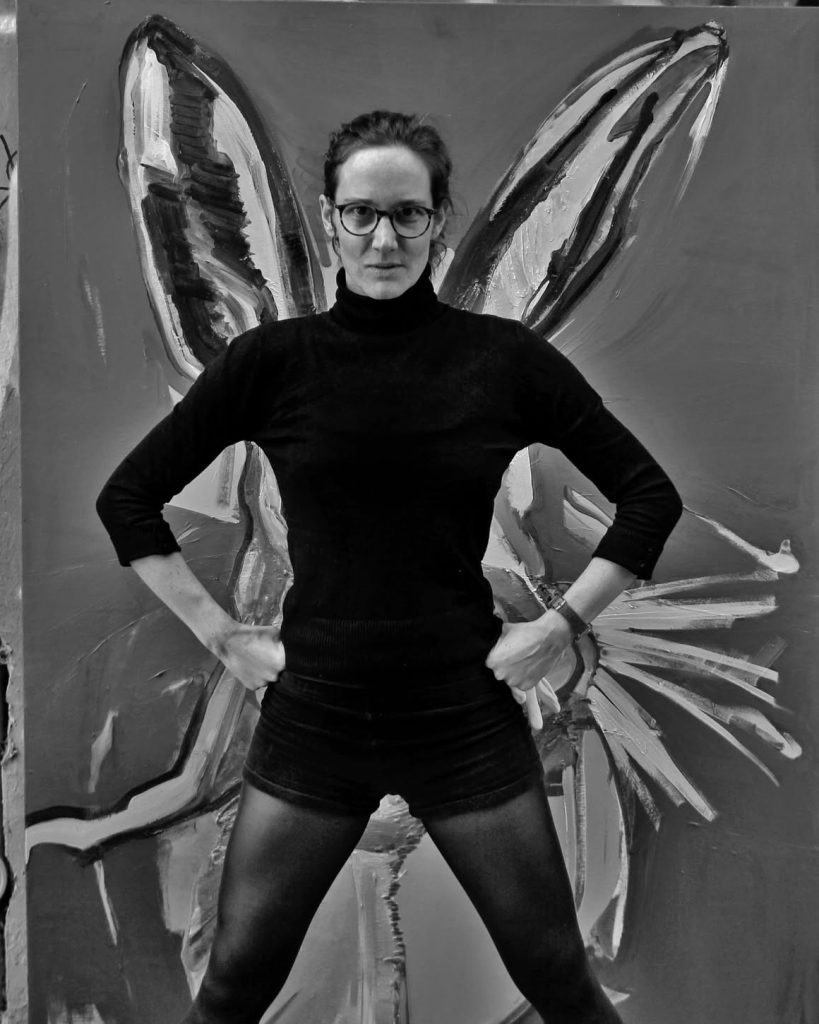
Tina Oelker lässt 1000 Hasen frei
Das Langzeitprojekt „1000 Hasen“ ist jetzt vollständig veröffentlicht. Die zwischen 2007 und 2014 entstandene Werkgruppe umfasst 1.000 Originalarbeiten.
Hamburg, 01. Oktober 2026. Tina Oelker gibt ihr Langzeitprojekt „1000 Hasen“ vollständig frei: Alle 1.000 zwischen 2007 und 2014 entstandenen Originalarbeiten sind ab jetzt online öffentlich zugänglich. Verfügbare Werke können direkt erworben werden.
Press Reviews


“Tina, jeder weiß doch, dass du die 1000 Hasen malst! Es heißt jetzt auch Hasentor!”
Harald Falckenberg, 2012
Kunstsammler


Harald Stazol, 2009
Tina Oelker’s Little Hare School by Dirk Pfaff, 2009
Deutscher Text im Anhang
The most seductive aspect of Tina Oelker’s art is allowing oneself to be carried away by the lightness and beauty of her painting. Anyone looking at the many colourful hares in her small-format pictures can hardly help but simply find them beautiful.
This is mainly due to the technical sophistication and compositional virtuosity with which she captures her bunnies on canvas: a new hare every day, each day a little different, always as a portrait – and done in such a way that the viewer cannot avoid looking the hare straight in the eye. Tina Oelker paints hares as if on a conveyor belt, ruthlessly.
The compulsion to repeat is the propellant that gives her the strength to take on these long-ears again and again. She has decided that the story will end with one thousand hares, but that is anything but certain.
In contrast to the serial production of Carl Andre, Donald Judd or Andy Warhol, Tina Oelker attaches great importance to the individual gesture of her painting, in which the personal does not disappear behind industrial production but – quite the opposite – is elevated to an artistic principle. That is why her studio is not run like a factory but more like a craft workshop. To dispel any doubt about this, there is a sign above her Hamburg studio that reads “Hasenmanufaktur” (Hare Manufactory).saatchiart+2
What is tricky about this serial mode of production, which does not copy but stubbornly creates something new over and over again, is the almost disconcerting harmlessness of her images. Once the gaze has become entangled in the many portraits of “Meister Lampe” and the absoluteness of pure aesthetics confidently claims its rights, the trap snaps shut: these hares, blown up to the point of banality and painted almost on autopilot in this absurd 1000-part series, rule out any critical reflection from the outset.
There are no ironic allusions and no hidden critical references that might allow one to place the painting in some broader art context. That is precisely what makes it so dangerous. That painting might be self-sufficient is one thing; but with so much carefully staged painterly affability, the scarcely perceptible dialectic at work here does not immediately reveal itself. The mere thought of it is suppressed from the start. This referenceless serial production, pushing right up to the threshold of the decorative, can, once one has seen the first hundred pictures, be understood as the expression of a fundamentally honest artistic strategy that is committed to a single idea: to restore beauty in painting to its rightful place.tinaoelker+1
This is a challenge that not only breaks a taboo but also includes every possibility of being thoroughly misunderstood. How could this be achieved better than by using the means of painting to express the essence of beauty itself? That attempt alone is enough to justify giving the viewer no chance to think and instead allowing them to be seduced again and again by this intoxication of colour that makes no move to question the laws of aesthetics.
In this context, one must mention Walter Benjamin and his fine phrase about “the work of art in the age of its technical reproducibility”, because he recognises the compulsive nature of repetition as the only viable path to art. In repetition, Benjamin sees the central, morally neutral background noise of life: “Only what can be repeated leads to art. Compulsions to repeat alone produce style; they alone convey to the recipient a sense of the necessary and the fated in a work.” It is above all the affability of Lepus europaeus that tempts one not to think of anything dark. This has mainly to do with the mimesis that manifests itself in the portrait views of the common field hare. The more often one looks into the hare’s eyes, because it always has the viewer in its sights, the more obvious Oelker’s intention becomes: to reveal the human in the animal.
It is above all the hare’s human pose that recalls photo-booth portraits: look straight ahead, keep still and hope that everything will fit into the frame. And that is usually how it turns out – in the photos as in Tina Oelker’s paintings. What is so compelling in this potentially endless portrait series is above all the depiction of the hare as a trophy. In every single picture, reverence for the animal’s wildness is at work, a wildness that cannot be tamed by any means. One should know that hares are extremely intractable and cannot be kept in captivity, in stark contrast to their doppelgängers, the rabbits, who only ever pretend to be hares. That they can nevertheless be pinned to the canvas is nothing more than an allegory of the hunt, pointing to the supposed superiority of civilisation over wildness.
Yet this insight does not really help. No more than the elevation of the tormented creature into a fetish that, even when presented a thousand times, scarcely loses any of its fascination. Pursuing such reflections would mean engaging with questions such as: Is the repetitive depiction of hares not in fact a silent accusation directed at their arch-enemy, the human being? “These questions,” says Tina Oelker, “all lead nowhere.” She says this because occupying oneself with such objections opens a breach through which concerns pour in that have nothing to do with her artistic strategy.
Her aim lies elsewhere entirely. This “elsewhere” relates to her body of work as a whole and not, as in the hare series, to one small spectrum of her artistic production. The business with the oh-so-cute hare is little more than a reflex to a trend-obsessed, hype-addicted art market. To name just one example: from the very beginning, the reaction of the art public to her wonderful, free drawings stood in a baffling disproportion to the response to her works in which there was even the slightest trace of – what else? – a hare to be made out. “As soon as someone spotted the contour of a hare in a drawing, all attention immediately shifted to that one work,” Tina Oelker explains, shaking her head.
It was no different with her performances and figurative large formats. If there was even the tiniest hint of a hare – which she would now and then insert in passing, with a wry, ironic smile – the initial reserve towards her work would suddenly turn into exuberant enthusiasm. Oelker could find no explanation for this reaction. The question was simply: Where did this rapture come from? Why were people of all things drawn to the hares, even when they could only be vaguely discerned? Did it perhaps have something to do with the “Sissi effect” that crushed actress Romy Schneider under the figure of the Austrian empress for the rest of her life, no matter what role she played? Was it such a great mistake ever to have drawn or painted a hare at all?
The easiest thing, of course, would have been to ignore these reactions and let hares be hares. But Tina Oelker did not want to make it so easy for herself. If the public was already lusting so eagerly after the bunnies while ignoring the strain this caused her, then, very well, they should have their hares. She became serious. She went hunting with hunters. She got a hunting licence. She shot a long-ear. Skinned it. Cooked it for hours. Then went stalking again to bag another one. Perhaps, she thought, she would understand why the hare had been running rings around her for so long. One could also say: Tina Oelker wanted, quite literally, to bring to ground the hare that threatened to become an obsession.
But life does not always follow the laws of art. Hence this exhausting, mad feat of strength. Hence this painting orgy that stretches to the very limits of what is bearable, a series at which one can feast one’s eyes until one can no more, again and again and again. And one should look into the hare’s eyes at least three hundred times in order to understand why Tina Oelker will keep working away at the hare until the hare theme is finally and definitively done with. Hopefully.
Die kleine Hasenschule der Tina Oelker von Dirk Pfaff, 2009
(Stand # 0266)